
Founder Story · Beauty · Haircare · Gurugram
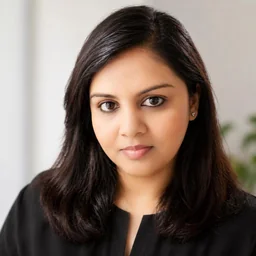
Nikita Khanna found her own curls in lockdown and built Moxie Beauty for the hair India actually has
Her blow dryer stopped, her natural waves appeared, and the haircare aisle turned out to have almost nothing for them. She left a McKinsey career to formulate for Indian hair, Indian water and Indian weather.
A great deal of Indian haircare has been sold on a single implied promise, that your hair should be straighter and smoother than it naturally is. Frizz is treated as a defect. Waves and curls are things to be tamed. Generations of women learned to manage their hair rather than to work with it, and an entire product category was built around that management.
Then the lockdowns arrived and a lot of routines simply stopped. For Nikita Khanna the interruption was her blow dryer. Without regular heat styling her hair reverted to what it had always been, wavy and spiralled, and she found herself looking at a texture she had spent years flattening.
The interesting part is what she did next. She went looking for products designed for that texture, in India, and found the shelf remarkably thin. Moxie Beauty, the brand she co-founded, exists to fill that gap, and it has since raised a round led by Fireside Ventures.
The McKinsey years
Khanna came to beauty from strategy consulting rather than from cosmetics. She was a senior engagement manager at McKinsey & Company, working in its consumer, technology and media practice, and by the accounts of her career she moved up quickly, earning a fast-track promotion to engagement manager.
The work was the sort that teaches structure rather than product. Profit and loss transformation for a publishing client, a five-year growth strategy for a global sports organisation, an operational overhaul at a shared mobility company. None of that is formulation science. All of it is training in how to size a market honestly, understand where margin actually sits and build a plan that survives contact with reality.
That background shows in how Moxie was built. It is a brand founded on a genuine product insight, but it was not launched on enthusiasm alone. The category was analysed first, which is why the positioning is narrower and more specific than most new beauty brands dare to be.
The lockdown that changed the product idea
The origin is unusually literal. During lockdown, with salons closed and daily styling abandoned, Khanna's hair returned to its natural wavy and curly state. Discovering your own hair texture in your late twenties sounds like a small thing. For a lot of Indian women it is not, because the styling was never really a choice so much as an inherited default.
What turned a personal discovery into a company was the search that followed. Once she wanted to care for the hair she actually had rather than the hair she had been producing with heat, she went looking for products formulated for it. The Indian market offered very little. International curly-hair brands existed, but they were formulated for other climates, other water and other hair types, and they were expensive to import.
She spent the following period going deep into the science of hair, which is the step most brand founders skip. The category is full of companies that pick a trending ingredient and design a bottle. Understanding porosity, curl pattern, protein and moisture balance is different work, and it is what allows a brand to make claims that survive contact with a customer's actual hair.
Why Indian hair needs Indian formulation
The most important argument Moxie makes is that hair products cannot be transplanted across geographies and expected to behave. Three variables make India distinct.
The first is water. Much of the country has hard water, heavy in dissolved minerals, and hard water changes how a cleanser behaves, how much residue is left behind and how hair feels afterwards. A shampoo formulated for the soft water of a European city can genuinely underperform in an Indian bathroom for reasons that have nothing to do with the hair itself.
The second is climate. India spans humid coasts, dry heat, dust and long monsoons. Humidity is the specific enemy of styled hair, because moisture in the air swells the hair shaft and produces the frizz that everyone is trying to prevent. A product designed for a temperate climate has not been asked to solve that problem.
The third is practice. Indian haircare carries deep habits, oiling in particular, which is close to universal across much of the country and which interacts with whatever else is applied. A brand that ignores oiling is either fighting its customers' routines or pretending they do not exist. Building for the water, the weather and the habits together is a meaningfully harder brief than importing a formula.
The brand and the partnership behind it
Moxie Beauty was founded by Khanna along with Anmol Ahlawat, previously a sales and growth leader at Paytm. The division of responsibility is clean, with Khanna driving brand and product and Ahlawat handling channels and operations, which is the sort of split that keeps a consumer company from being strong at storytelling and weak at distribution.
The first range was aimed at frizzy, wavy and curly hair, which is a deliberately narrow opening position for a haircare brand in a market where the volume sits in mass shampoo. Narrow is the point. A brand that speaks precisely to people who have been ignored earns loyalty that a general-purpose product cannot, and those customers tend to talk, because they have spent years failing to find something that works.
The brand has been positioned as clean and science-led, and its communication leans on explanation rather than on promising transformation. That is consistent with a founder who spent months learning the underlying science and who came from a profession where claims have to be defensible.
Funding and the market it is chasing
Moxie Beauty raised about 17.3 crore rupees in a round led by Fireside Ventures, one of the more experienced consumer-brand investors in India, whose portfolio has included several of the country's better-known D2C names. Other backers have included Amplify Partners.
Fireside leading a haircare brand is a meaningful signal, because the firm has watched many consumer categories closely enough to know where a genuine gap exists rather than a marketing angle. Indian haircare is a very large market, worth billions of dollars, and it is one of the last big beauty categories where the assortment on the shelf still lags the diversity of the customers buying from it.
The competitive reality is demanding. Haircare is dominated by multinational giants with enormous distribution and advertising budgets, and a young brand cannot win on reach. It wins by being genuinely better for a specific set of people, holding on to them, and letting that group widen. That is a slower path than category-wide advertising, and it is the only one available.
Founder Snapshot
- Name
- Nikita Khanna
- Company
- Moxie Beauty
- Role
- Co-founder
- Co-founder
- Anmol Ahlawat, previously a sales and growth leader at Paytm
- Founded
- Started around late 2021, brand launched 2022
- Sector
- Haircare, D2C beauty
- Earlier career
- Senior Engagement Manager, McKinsey & Company, consumer technology and media practice
- Origin
- Discovered her natural wavy and curly hair during lockdown when she stopped heat styling, and found almost no Indian products formulated for it
- Product focus
- Haircare built for Indian hair textures, hard water, humidity and local practices such as oiling; first range for frizzy, wavy and curly hair
- Funding
- About 17.3 crore rupees in a round led by Fireside Ventures, with backers including Amplify Partners
Nikita Khanna’s net worth and ownership
There is no verified public net-worth figure for Nikita Khanna. Moxie Beauty is a private company and has not disclosed the valuation attached to its funding, and her individual shareholding, held alongside her co-founder and the brand's investors, is not on the public record.
Reported totals for the company's fundraising vary between sources, which is common for young D2C brands where small rounds and extensions get counted differently. The figure that is clearly attested is the round of roughly 17.3 crore rupees led by Fireside Ventures. Beyond that, any personal wealth figure attached to her name online is guesswork, and the honest position is that her stake is paper value in a brand still building its category.
What Nikita Khanna’s story teaches Indian founders
The first lesson is that a personal frustration is only a business if the gap it reveals is structural. Plenty of people disliked their frizz. What made this a company was noticing that the absence of good products for wavy and curly Indian hair was not an oversight by one brand but a pattern across an entire market, produced by decades of selling straightness as the goal. Individual annoyance is an anecdote. A pattern is an opportunity.
The second is that localisation can be a real technical moat rather than a marketing line. Any brand can claim to be made for India. Formulating around hard water, monsoon humidity and an oiling habit is chemistry work that a global competitor will not do for a single market, because its formulas are built for scale across many. The places where a multinational cannot economically follow you are exactly where a local brand should build.
The third concerns starting narrow on purpose. Launching a haircare brand aimed at frizzy, wavy and curly hair rules out most of the market at the outset, which feels like leaving money on the table. It is the opposite. A specific product for an underserved group creates advocates, and advocates are how a small brand grows without buying attention it cannot afford.
Frequently asked questions about Nikita Khanna and Moxie Beauty
Who is Nikita Khanna?
Nikita Khanna is a co-founder of Moxie Beauty, an Indian haircare brand. She was previously a senior engagement manager at McKinsey & Company in its consumer, technology and media practice, and started work on the brand after discovering her own natural wavy and curly hair during lockdown.
What does Moxie Beauty make?
Moxie Beauty makes haircare formulated specifically for Indian conditions, taking account of hair textures, hard water, the country’s varied and humid climate zones and local practices such as oiling. Its first range was aimed at frizzy, wavy and curly hair types.
How did Moxie Beauty start?
During lockdown Khanna stopped using her blow dryer, and her hair returned to its natural wavy and curly state. When she looked for Indian products formulated for that texture she found very little, and went on to study the science of haircare before founding the brand with Anmol Ahlawat.
Who are the founders of Moxie Beauty?
The brand was founded by Nikita Khanna and Anmol Ahlawat, previously a sales and growth leader at Paytm. Khanna drives brand and product while Ahlawat handles channels and operations.
How much funding has Moxie Beauty raised?
Moxie Beauty raised about 17.3 crore rupees in a round led by Fireside Ventures, with backers including Amplify Partners. Reported totals vary across sources, so the clearly attested figure is the Fireside-led round.
What is Nikita Khanna’s net worth?
There is no verified public net-worth figure. Moxie Beauty is private and has not disclosed a valuation, and her individual shareholding is not on the public record, so any figure circulating online is unverified.
Your story could be next
Building a startup of your own?
We publish researched, permanent founder features like this one — profiles that keep ranking for your name and your company long after a social post fades. Sponsored placement, quoted per founder, with a guaranteed publish date.
Our newsletter
The Bright Story
If this one stayed with you, get the next one before chai — a single women-led story, researched and anchored only in verifiable facts. No noise, unsubscribe anytime.
Keep reading
Malini Adapureddy started Deconstruct in her garage and grew it into a 200 crore skincare brand
Beauty · InclusiveKarishma Kewalramani Built FAE Beauty to Make Makeup More Inclusive
Beauty · OrganicMegha Asher built Juicy Chemistry into India’s first certified organic beauty brand
Beauty · OrganicNatasha Tuli was an architect who started making soap, and built one of India's clean-beauty pioneers before the category had a name
BeautyFalguni Nayar walked out of a top banking job at 50, and built Nykaa into a listed beauty giant
BeautyVineeta Singh turned down a ₹1 crore offer, and built SUGAR Cosmetics
More for founders
- Women-led startup directorySearch 100+ women-led Indian companies by industry, city, funding stage and year.
- VC directoryWhich funds invest in India, at what stage and cheque size, and who they’ve backed.
- Startup trends & dataLive charts of women-led startups in India — sectors, funding stages and cities.
- Free founder toolkit100+ directories, grants, PR, templates, AI tools and India’s schemes.
- Funding MatchFind the government funding you actually qualify for — in 60 seconds.
- Templates & checklistsPitch deck, cap table, term sheet and founders’ agreement.
Comments
No comments yet — be the first to add one.