
Founder Story · Fintech · Neobank · Bengaluru
How Mabel Chacko co-built Open into one of India’s fintech unicorns
A business-banking layer for SMEs, built by a founding team that had been trying to fix payments for years before Open worked.

Open is usually described as one of India’s fastest fintech unicorns, which is true and also the least interesting thing about it. The accurate version is that Mabel Chacko and her co-founders had already spent years building and running payments and API-banking ventures before Open found the wedge that worked, a banking layer built around how a small business actually moves money. The speed people remember was the visible tail of an apprenticeship most observers never saw.
A payments operator, not a generalist
Chacko’s formation is in payments and banking technology, and that specificity is the asset. In consumer internet, a fresh idea and good design can carry a company a long way; in regulated, bank-dependent fintech, the durable edge is accumulated, scar-tissue knowledge of how Indian payments rails, partner banks and compliance actually behave under load. Open was not built by people learning that on the customer’s money, it was built by a team that had already absorbed those failures elsewhere, which is why it competes on integration depth and reliability rather than on a marketing story.
Why “overnight” is the wrong word
Before Open, Chacko and the founding team, Anish Achuthan, Ajeesh Achuthan and Deena Jacob, had worked together on earlier payments and API-banking businesses. This is the single most load-bearing fact in the story. Open was not a first attempt; it was the next iteration of a team that had already discovered, the hard way, where Indian banking infrastructure breaks and what SMEs will and won’t adopt. The execution speed after 2017 was not luck or genius in a vacuum, it was a repeat team compounding earlier, unglamorous lessons.
The SME money-operations problem
The gap was the small-business owner’s daily reality. Business banking, payments, payouts, GST and accounting, vendor settlement and reconciliation lived in disconnected tools bolted onto slow legacy bank flows, a founder doing finance ops by stitching together a bank portal, spreadsheets and three apps. Open’s thesis was to collapse that into “connected banking”: a single financial control surface sitting on top of partner banks. The strategic bet underneath it is sharp, owning the SME’s money-operations cockpit is far stickier than owning any one transaction, because the cockpit is where the business lives every day.
The hard part: you do not own the bank
A business neobank holds no banking licence; it sits on regulated partner banks. That single fact makes the hard problems structural rather than technical: dependence on partner banks whose priorities you don’t control, acute regulatory sensitivity, and the slow work of persuading risk-averse SME owners to route their actual money operations through a startup. The wall was never the app, it was distribution and institutional trust, the kind a polished product cannot buy and only credibility, integrations and time can. The same dependency that enables the model is also its permanent risk.
Funding and the 2022 peak
Open raised multiple venture rounds from prominent investors and was widely reported to enter unicorn valuation in 2022 on a large round, just before the global fintech funding climate tightened sharply. We treat that valuation as exactly what it is: a point-in-time private mark from a specific capital cycle, not a durable fact, and we do not print a figure the public record cannot stand behind today. The verifiable, durable point is the milestone itself, an SME-focused connected-banking company reaching unicorn-stage backing, and the more useful lens is the embeddedness of the model rather than the headline number.
Open startup timeline
- Pre-2017, Founding team builds and operates earlier payments ventures.
- 2017, Open founded to build connected business banking for SMEs.
- 2022, Widely reported to reach unicorn valuation on a large funding round.
- Post-2022, Expands the business-finance product suite amid a tighter global fintech funding climate.
Open business model
A business-banking and finance-operations layer over partner banks, payments, payouts, accounting, reconciliation and connected banking for SMEs, monetised through transaction economics plus SaaS-style subscriptions rather than a banking licence. The model’s strength is embeddedness: once a business runs its money operations through Open, switching cost is high; its dependency is the same fact inverted, the partner banks underneath.
Open competitors
In Indian SME/business banking it competes with RazorpayX, Cashfree and other neobanking and business-payments players, and increasingly with banks’ own digital SME offerings. The real contest is for the SME’s default financial cockpit: many players can move a payment, but whoever owns the control surface and the integrations underneath it owns the relationship.
Growth strategy
Three choices: enter at the SME’s control surface rather than a single payment, so the product becomes the cockpit; bundle disconnected money operations until switching away is painful; and treat deep partner-bank integration as the moat, the part newer entrants cannot replicate quickly because it is relationship and compliance work, not code.
Founder Snapshot
- Name
- Mabel Chacko
- Company
- Open Financial Technologies
- Role
- Co-founder & COO
- Founded
- 2017
- Headquarters
- Bengaluru, India
- Status
- Private; widely reported unicorn (2022)
- Sector
- Fintech / business neobank
What Mabel Chacko’s story teaches founders
Two things travel. First, “overnight” fintech success is almost always a multi-venture apprenticeship in disguise, the visible speed is paid for by invisible earlier failures, and a repeat team on the same problem is one of the most underrated advantages in the category. Second, in regulated, partner-dependent fintech the moat is not the interface but integration depth, compliance muscle and institutional trust, relationship-and-plumbing work that newer entrants cannot clone quickly, and the same dependency that has to be managed as the standing risk.
Frequently asked questions about Mabel Chacko
Who is Mabel Chacko?
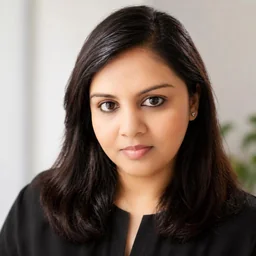
Mabel Chacko is an Indian fintech entrepreneur and a co-founder and COO of Open, a business-banking neobank for SMEs. She and her co-founders built earlier payments ventures before Open, which was widely reported to reach unicorn valuation in 2022.
What is Mabel Chacko’s net worth?
This is a privately held company, so there is no disclosed valuation or public net-worth figure; the founder’s stake is a private holding rather than a listed, market-priced one.
What does Open do?
Open provides connected business banking for SMEs, payments, payouts, accounting and reconciliation on top of partner banks, monetised through transactions and subscriptions.
What can founders learn from Mabel Chacko?
That fintech “overnight” wins are usually built on prior failed attempts, and that integration depth and trust, not the app, are the moat in regulated, bank-dependent fintech.
More founder journeys: women founders in fintech · women in fintech database · women founders in Bengaluru.
Your story could be next
Building a startup of your own?
We publish researched, permanent founder features like this one — profiles that keep ranking for your name and your company long after a social post fades. Sponsored placement, quoted per founder, with a guaranteed publish date.
Our newsletter
The Bright Story
If this one stayed with you, get the next one before chai — a single women-led story, researched and anchored only in verifiable facts. No noise, unsubscribe anytime.
Keep reading
Akkineni Keerthi built innopay into a fintech millions use, without raising a single rupee
Fintech · StartupsShanti Mohan left a long tech career to build the plumbing for Indian angel investing
Fintech · UnicornRuchi Kalra co-founded two profitable unicorns, and made Oxyzo one at its Series A
FintechUpasana Taku left PayPal in Silicon Valley to build MobiKwik in Delhi
Fintech · InclusionSucharita Mukherjee left investment banking to build money rails for India’s informal economy
Fintech · Asset MgmtRadhika Gupta co-founded a quant fund, sold it to Edelweiss, then ran the whole fund house
More for founders
- Women-led startup directorySearch 100+ women-led Indian companies by industry, city, funding stage and year.
- VC directoryWhich funds invest in India, at what stage and cheque size, and who they’ve backed.
- Startup trends & dataLive charts of women-led startups in India — sectors, funding stages and cities.
- Free founder toolkit100+ directories, grants, PR, templates, AI tools and India’s schemes.
- Funding MatchFind the government funding you actually qualify for — in 60 seconds.
- Templates & checklistsPitch deck, cap table, term sheet and founders’ agreement.
Comments
No comments yet — be the first to add one.