
Founder Story · Rural Commerce · Clean Energy · Jaipur
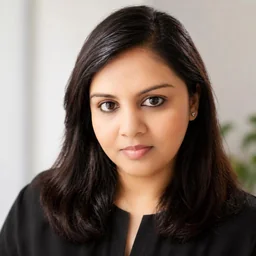
Ajaita Shah built a rural commerce company where every single seller is a woman
Seven years inside Indian microfinance taught her that villages were not short of products or of credit. They were short of somebody trustworthy to buy from. Her answer was to hire the women already living there.
Ask why a village household in rural Rajasthan does not own a solar light, and the usual answers arrive quickly. Too poor. No electricity. No awareness. Ajaita Shah spent seven years working across rural India and concluded that most of those answers are wrong, or at least secondary. Rural families do buy things. They spend on kerosene, on phone recharges, on medicines and on repairs. The real obstacle is that almost nobody they trust is selling them anything worth having.
A stranger arrives in a village with a solar lamp and a price. Where is he in six months when it stops working? Who fixes it? Whom do you complain to? Distribution in the last mile is not a logistics problem about roads and warehouses. It is a trust problem. Shah's answer to it was direct. Make the seller a woman who already lives in the village, whose reputation is on the line, who cannot disappear because it is her home.
That is Frontier Markets, the company she founded in 2011, and its salesforce is entirely female. The women are called Saral Jeevan Sahelis, and they sell clean energy products, appliances and digital services to their own neighbours, earning commissions in a place where almost no formal earning opportunity exists for women.
An American graduate who moved toward the problem
Shah studied international relations at Tufts University in the United States. In 2006 she came to India as a fellow of the American India Foundation, which is the kind of one-year placement that usually ends with a return flight and a good line on a resume. She stayed.
What kept her was microfinance, then near the peak of its influence as the sector that had supposedly solved rural poverty. She worked with organisations including SKS Microfinance and Ujjivan Financial Services, and spent roughly seven years in the field across a number of Indian states. This was not policy work at a distance. It meant sitting in villages, meeting borrowers, understanding how women in low-income rural households actually handle money, and watching what happened after the loan was disbursed.
The lesson microfinance taught her
Microfinance proved something important. Poor rural women are reliable borrowers, they repay, and they can manage capital. But Shah watched the limits of the model closely, in the years when the Indian sector went through its own painful reckoning over aggressive lending. A loan delivers money. It does not deliver anything to spend it well on.
A woman could borrow to buy a solar system and still end up with a bad product sold by someone who never came back, no way to get it repaired, and a debt to service. The credit side of rural life had been built out substantially. The supply side, the actual goods and the service behind them, had not. Shah's insight was to move one step down the chain, from financing consumption to fixing what was available to consume.
There was a second observation underneath it. In all those years of microfinance the trusted node in a village was consistently a woman. She was in the self-help group, she knew every household, she handled the money. That trust was a distribution asset that nobody was using commercially.
Frontier Markets and the Saheli model
Frontier Markets began in 2011, working out of Rajasthan, and started with modest, high-utility goods. Torches and solar lanterns first, sold through last-mile distribution points and in cooperation with rural traders. Solar lighting is a good opening product for a specific reason. The benefit is immediate and obvious, a house that had kerosene smoke now has light, and the saving on kerosene is visible within weeks.
The model matured into something more interesting than product sales. The company built a network of village women, the Saral Jeevan Sahelis, who form the entire salesforce and the after-sales service layer. They are supported by micro distribution hubs that handle stock and delivery, and by a purpose-built app, the Meri Saheli app, through which a Saheli places orders, tracks commissions and manages her customers.
The catalogue widened well beyond lighting into home appliances, agricultural products, digital and financial services and other essentials. Reported scale has grown over the years. Accounts of the company describe a Saheli network in the region of ten thousand serving around 700,000 households across roughly 2,000 villages, with later accounts citing substantially larger numbers as the platform expanded into more states. The company has operated across states including Rajasthan, Uttar Pradesh, Bihar and Odisha.
What the model does for the women who run it
The elegance here is that the distribution solution and the social outcome are the same thing. Frontier Markets needs a trusted village seller. The village woman needs an income she can earn without leaving home or defying local norms about where women may work. Each solves the other's problem.
For a Saheli the effects compound in ways that a wage job would not. She earns commission income of her own. She acquires genuinely commercial skills, selling, handling a smartphone app, managing customers, tracking money. She becomes the person in the village who knows how the solar system works and where the replacement part comes from, which is a position of real standing. Women who begin as customers frequently become Sahelis themselves, which is how the network grows without a recruitment department.
It is worth being clear-eyed about what this is not. Commission earnings from village-level sales are supplementary income, not a salary that transforms a household overnight. The honest description is that it puts money and standing in the hands of women who had access to neither, in places where the alternative is usually nothing at all.
Funding, and why this business is hard to scale
Frontier Markets has raised roughly 4.8 million dollars across several rounds by Tracxn's count, with its largest disclosed round at about 2.25 million dollars. The investor list reflects the company's hybrid nature, led by ENGIE Rassembleurs d'Energies, the impact investment arm of the French energy group, alongside The Rise Fund, the Singh Family Trusts advised by Artha Impact, and Teja Ventures.
That is a modest total for a company operating across thousands of villages, and the reason is instructive. This is not a business that can be scaled by buying digital advertising. Every new district requires recruiting and training real women, establishing physical stock, and building trust that cannot be accelerated with a discount. Margins on low-cost rural goods are thin, and the cost of serving a remote village is stubbornly high.
Shah has spent years being recognised for the work, appearing on lists such as Forbes 30 Under 30 and receiving awards for social entrepreneurship, and the recognition has generally run ahead of the capital. That gap is the honest state of last-mile rural commerce in India. It is strategically important, socially valuable and commercially punishing, which is precisely why so few people attempt it and why the ones who do deserve attention.
Founder Snapshot
- Name
- Ajaita Shah
- Company
- Frontier Markets
- Role
- Founder & CEO; president of the Frontier Innovations Foundation
- Founded
- 2011
- Base
- Rajasthan, India
- Sector
- Last-mile rural commerce, clean energy access, assisted e-commerce
- Education
- B.A. International Relations, Tufts University
- Earlier career
- American India Foundation fellow (2006); around seven years in microfinance, including SKS Microfinance and Ujjivan
- Model
- Saral Jeevan Sahelis, an all-women village salesforce, supported by micro distribution hubs and the Meri Saheli app
- Reported reach
- A Saheli network reported in the region of ten thousand, serving around 700,000 households across roughly 2,000 villages, with later accounts citing higher figures
- Funding
- About 4.8 million dollars total (Tracxn); largest disclosed round about 2.25 million dollars led by ENGIE Rassembleurs d’Energies with The Rise Fund, Singh Family Trusts and Teja Ventures
Ajaita Shah’s net worth and ownership
There is no verified public net-worth figure for Ajaita Shah. Frontier Markets is a private company that has not disclosed a valuation, and her individual shareholding is not on the public record. With roughly 4.8 million dollars raised across multiple rounds and impact-oriented investors on the register, founder equity will have been diluted along the way, and whatever remains is paper value in a business still working toward scale. Any rupee or dollar figure attached to her name online is invented.
The number that describes the work better is the reach. Hundreds of thousands of rural households buying goods they could not previously get reliably, through a network of village women who now earn from selling them.
What Ajaita Shah’s story teaches Indian founders
The first lesson is to identify the real constraint rather than the obvious one. Everyone assumed rural households did not buy solar because they were too poor. Shah, having spent seven years actually in those villages, saw that the binding constraint was trust and service, not affordability or awareness. Getting the constraint wrong means solving the wrong problem elegantly, which is a common and expensive mistake.
The second is that the best business models make the social outcome structural rather than optional. Frontier Markets does not sell products and separately run a women's empowerment programme. The women are the distribution, so the company cannot grow without their earning growing. When impact is built into the mechanism, it survives a bad quarter. When it is a department, it does not.
The third concerns patience with unfashionable markets. Last-mile rural commerce has none of the characteristics venture capital prefers. It is capital-hungry, slow, physical and low-margin. Shah has stayed with it for well over a decade. Some problems are worth solving on their own timeline rather than the funding cycle's, and India has a great many of them outside its metros.
Frequently asked questions about Ajaita Shah and Frontier Markets
Who is Ajaita Shah?
Ajaita Shah is the founder and CEO of Frontier Markets, a rural commerce and clean energy distribution company in India. She studied international relations at Tufts University, came to India as an American India Foundation fellow in 2006, and spent about seven years in microfinance with organisations including SKS Microfinance and Ujjivan before founding the company in 2011.
What does Frontier Markets do?
It is a last-mile rural commerce company selling clean energy products such as solar lighting, along with home appliances, digital and financial services and other essentials, to households in remote Indian villages. Orders and after-sales service run through a network of village women entrepreneurs, supported by micro distribution hubs and the Meri Saheli app.
Who are the Saral Jeevan Sahelis?
They are rural women who make up the entire salesforce and service network of Frontier Markets, selling and supporting products in their own villages and earning commission income. Reported network size has been cited in the region of ten thousand, with later accounts citing considerably higher numbers as the platform expanded.
How much funding has Frontier Markets raised?
Roughly 4.8 million dollars across several rounds by Tracxn’s count. The largest disclosed round was about 2.25 million dollars, led by ENGIE Rassembleurs d’Energies with The Rise Fund, the Singh Family Trusts advised by Artha Impact, and Teja Ventures participating.
What is Ajaita Shah’s net worth?
There is no verified public net-worth figure. Frontier Markets is a private company that has not disclosed its valuation, and her individual shareholding is not on the public record, so any specific figure circulating online is unverified.
Your story could be next
Building a startup of your own?
We publish researched, permanent founder features like this one — profiles that keep ranking for your name and your company long after a social post fades. Sponsored placement, quoted per founder, with a guaranteed publish date.
Our newsletter
The Bright Story
If this one stayed with you, get the next one before chai — a single women-led story, researched and anchored only in verifiable facts. No noise, unsubscribe anytime.
Keep reading
Garima Luthra started Vaaree because India’s best home textiles were all being exported
E-commerce · PioneerAnisha Singh was an early woman of the Indian internet, and now funds the next ones
E-commerceRicha Kar built Zivame to give Indian women a private way to shop lingerie
E-commerce · SetbackRadhika Aggarwal co-founded ShopClues, India’s first unicorn with a woman co-founder, and lived through its long unwinding
D2C · Upcycled FoodHow Aditi Jhala Left Finance to Build a Business Around Unwanted Produce
Craft · AccessoriesNikita Shekhawat spent a lockdown with Jaipur's block printers and built a bag label from it
More for founders
- Women-led startup directorySearch 100+ women-led Indian companies by industry, city, funding stage and year.
- VC directoryWhich funds invest in India, at what stage and cheque size, and who they’ve backed.
- Startup trends & dataLive charts of women-led startups in India — sectors, funding stages and cities.
- Free founder toolkit100+ directories, grants, PR, templates, AI tools and India’s schemes.
- Funding MatchFind the government funding you actually qualify for — in 60 seconds.
- Templates & checklistsPitch deck, cap table, term sheet and founders’ agreement.
Comments
No comments yet — be the first to add one.