
Founder Story · Health Tech · Social Enterprise · Mumbai
How Suhani Mohan left investment banking to make sanitary pads where women actually live
An IIT Bombay engineer who quit a banking career to attack menstrual-hygiene access at the manufacturing layer, by decentralising the machine, not just the product.

Most menstrual-hygiene ventures sell pads. Suhani Mohan co-founded Saral Designs on a different premise: the binding constraint in India was not the product but where it could be made, so she went after the manufacturing machine.
Early life
Suhani Mohan’s story turns on a deliberate, costly pivot, leaving a high-status finance career for a social-impact engineering problem. That choice is not biography but thesis: the company exists because she concluded the menstrual-hygiene gap was an engineering and distribution problem, not a charity one.
Education
She is an engineering graduate of IIT Bombay, a credential frequently cited in coverage and load-bearing rather than decorative here. Saral Designs’ core is a hard mechanical-engineering problem, designing a compact, automated, reliable pad-making machine, so a founder who can actually reason about machine design, not just brand a product, is the difference between a real venture and a campaign.
Career before Saral Designs
Before Saral Designs, Mohan worked in investment banking (widely reported, including at Deutsche Bank) before leaving to co-found the company with Kartik Mehta. The pivot is the decision the story turns on: it signals conviction, but more practically it gave her the capital-markets fluency to fund a hardware-and-impact venture through grants, impact investors and partnerships rather than the venture rounds such a model rarely fits.
Why she started Saral Designs
The insight was structural, not emotional. Sanitary-pad manufacturing in India was centralised and capital-heavy, which meant distribution to low-income and rural women stayed expensive, patchy and dependent on subsidy. Saral Designs attacked that root cause by decentralising production itself, compact, automated machines that let pads be made close to where they are used, reframing access as a manufacturing-location problem rather than a donation problem.
The early struggle
Hardware aimed at a price-sensitive, taboo-laden, impact-driven market is close to the hardest possible combination: machine engineering and uptime, quality consistency across many decentralised sites, financing for buyers who lack capital, and the cultural work around menstruation itself. Demand was never the question, the difficulty was building machines dependable enough that decentralised production did not mean inconsistent product, and a model that could pay for all of it.
Funding & revenue
Saral Designs has been supported through a mix of impact-oriented investment, grants and partnerships rather than headline venture mega-rounds, and Mohan has received recognition including Forbes 30 Under 30-type honours. That financing path is itself the strategy: a decentralised-manufacturing impact model has long payback and modest equity-style returns, so it is structurally better matched to patient impact and institutional capital than to scale-at-all-costs venture money.
Saral Designs startup timeline
- Education, Graduates in engineering from IIT Bombay.
- Early career, Works in investment banking before leaving to address menstrual-hygiene access.
- ~2015, Co-founds Saral Designs with Kartik Mehta to decentralise sanitary-pad manufacturing.
- Following years, Develops automated pad-making machines and a quality-assured decentralised model; receives social-impact recognition.
Saral Designs business model
Sell and deploy compact, automated sanitary-pad manufacturing machines and support quality-assured decentralised production, so pads can be made close to underserved markets rather than shipped from distant centralised plants. It is a machine-and-enablement model, not a single consumer brand, which makes the buyer (entrepreneurs, institutions, NGOs running local units) and the moat (machine reliability plus a quality-assurance system) fundamentally different from a D2C pad company’s.
Saral Designs competitors
In low-cost menstrual-hygiene manufacturing it operates near social-enterprise efforts such as Aakar Innovations and the broader decentralised-production and affordable-pad space, while centralised mass producers set the price and quality baseline customers compare against. The differentiation is specific: automation and standardised quality control, which is what stops “decentralised” from becoming a synonym for “inconsistent”, the failure mode that sinks most local-production efforts.
Growth strategy
Three deliberate choices: attack the constraint one layer up, own the machine, not the pad, so a single sale can seed an entire local supply; engineer automation and quality control as the real product, since decentralised credibility lives or dies on consistency; and match financing to the model by using impact capital and partnerships rather than venture money whose return clock the model cannot satisfy.
Founder Snapshot
- Name
- Suhani Mohan
- Co-founder
- Kartik Mehta
- Company
- Saral Designs Solutions
- Founded
- ~2015
- Headquarters
- Mumbai, India
- Education
- IIT Bombay
- Sector
- Menstrual health / manufacturing tech
What Suhani Mohan’s story teaches Indian founders
That solving a problem one layer up, at manufacturing rather than at the product, can unlock distribution that product-only approaches structurally cannot, and that a career pivot is most defensible when it is aimed at a constraint everyone else has mis-located. The transferable move is the reframing itself: from “sell more pads” to “make pads makeable anywhere,” which changes who the customer is, what the moat is, and which kind of capital fits.
Sources & verification
This profile is anchored only in publicly verifiable facts. Key claims, above all that Suhani Mohan founded Saral Designs, are supported by:
- Suhani Mohan co-founded Saral Designs (with Kartik Mehta); decentralised, automated sanitary-pad manufacturing model, Saral Designs’ own public materials and mainstream Indian startup/social-impact coverage of the company (e.g. YourStory, The Better India and similar outlets).
- IIT Bombay engineering background; prior investment-banking career; social-impact recognition, Forbes India 30 Under 30-type recognition and widely published profile interviews; consistent across multiple independent outlets.
Frequently asked questions about Suhani Mohan
Who is Suhani Mohan?
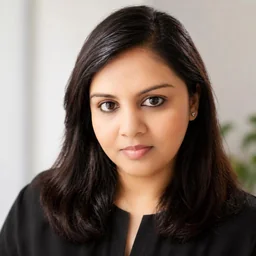
Suhani Mohan is an Indian social entrepreneur and IIT Bombay engineer who left an investment-banking career to co-found Saral Designs with Kartik Mehta, a venture decentralising sanitary-pad manufacturing through compact automated machines so pads can be made closer to underserved markets.
What is Suhani Mohan’s net worth?
Saral Designs is privately held, so there is no disclosed valuation or public net-worth figure for Suhani Mohan; it is an impact-led, capital-light venture and her stake is a private founder holding rather than a market-priced one.
What does Saral Designs do?
Saral Designs builds compact, automated sanitary-pad manufacturing machines and supports quality-assured decentralised production, so menstrual-hygiene products can be made closer to the women who need them rather than only in centralised plants.
What can founders learn from Suhani Mohan?
That moving a problem up a layer, from selling a product to enabling its manufacture anywhere, can unlock distribution that product-only approaches cannot, and that a career pivot is strongest when aimed at a mis-located constraint.
More founder journeys: women founders in health · first-generation women founders · women founders in Mumbai.
Your story could be next
Building a startup of your own?
We publish researched, permanent founder features like this one — profiles that keep ranking for your name and your company long after a social post fades. Sponsored placement, quoted per founder, with a guaranteed publish date.
Our newsletter
The Bright Story
If this one stayed with you, get the next one before chai — a single women-led story, researched and anchored only in verifiable facts. No noise, unsubscribe anytime.
Keep reading
Achitha Jacob, the Proactive For Her founder story
Health Tech · PediatricNishita Thakur is building the pediatric health system India needed
Health Tech · Mental HealthHow Richa Singh built YourDOST to make asking for help normal
Health TechMeena Ganesh sold an edtech company to Pearson, then built healthcare that comes to your door
Health TechAnu Acharya, a physicist turned genomics entrepreneur, built Mapmygenome to put personalised health in Indian homes
Femtech · AyurvedaRachana Gupta co-founded Gynoveda to treat PCOS and period disorders with Ayurveda, not painkillers
More for founders
- Women-led startup directorySearch 100+ women-led Indian companies by industry, city, funding stage and year.
- VC directoryWhich funds invest in India, at what stage and cheque size, and who they’ve backed.
- Startup trends & dataLive charts of women-led startups in India — sectors, funding stages and cities.
- Free founder toolkit100+ directories, grants, PR, templates, AI tools and India’s schemes.
- Funding MatchFind the government funding you actually qualify for — in 60 seconds.
- Templates & checklistsPitch deck, cap table, term sheet and founders’ agreement.
Comments
No comments yet — be the first to add one.