
Founder Story · Spacetech · Education · Chennai
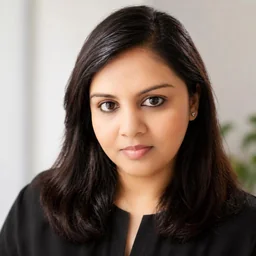
Srimathy Kesan went from eighteen years as a homemaker to launching students’ satellites with Space Kidz India
Married at eighteen, at home for the next eighteen years, she walked into a NASA booth at a conference in her forties and did not walk out the same person. Space Kidz India, the venture she built afterwards, has helped Indian schoolchildren, including 750 girls, put satellites into space.
Most of the founders in this magazine started young, with a degree that pointed at the thing they built. Srimathy Kesan started at forty, with no background in engineering, no science degree, and eighteen years of being a full-time homemaker behind her. What she built is an organisation that has helped Indian schoolchildren design and launch satellites carried by ISRO and NASA. It is one of the more improbable founder stories in Indian technology, and all of it is true.
Space Kidz India, which she started around 2011, is not a typical startup. It is an experiential space-science venture that takes ordinary students, many of them from rural government schools, and has them build real hardware that actually flies. Along the way it has produced the world’s lightest satellite and India’s first satellite built almost entirely by girls. This is how a homemaker from Hyderabad ended up being called the czarina of Indian spacetech.
Early life
Srimathy grew up in Hyderabad, an athletic and ambitious student. She was an NCC cadet who led the Andhra student contingent, and she wanted to join the armed forces. Life took the turn it took for a great many Indian women of her generation: she was married at eighteen, before she had even finished her graduation, and the plans she had for herself were quietly set aside.
What followed was roughly eighteen years as a homemaker. It is worth pausing on that number, because it is the whole point of this story. She did not spend those years building toward a company. She spent them raising a family, with her own ambitions on hold, which is exactly why what came next is so striking. There is no reliable public record of her birth year, so this piece will not invent one.
Education
Srimathy is, in her own description, a citizen scientist rather than a trained one. She took a commerce degree, completing her graduation in 1993, and later added a master’s in tourism and a PhD in education, which is where the "Dr." in her name comes from. Not one of those qualifications is in aerospace, physics or engineering.
This matters more than a conventional CV would, because it reframes what she actually built. She is not an engineer who founded a space company. She is a builder of programmes, teams and belief, who surrounded herself with young technical talent and gave them a mission big enough to rise to. The satellites are built by students and engineers. What Srimathy builds is the conditions in which a schoolchild dares to build a satellite at all.
The moment that started it
The turn came in 2009. Srimathy was at a business conference in Miami, and she wandered into a NASA booth, where she met a former astronaut. Something in that conversation lit a fuse. She came back to India convinced that space did not have to be the closed preserve of a handful of scientists and government agencies, and that Indian children, given the chance and the equipment, could do real space science themselves.
Around 2011 she started Space Kidz India to act on that conviction, formally registering it as a company a few years later. The early work was experiential science education: workshops, high-altitude balloon experiments, small payloads, the kind of hands-on programmes that were almost nonexistent for Indian schoolchildren at the time. She was building an audience and a method before she ever reached for orbit.
KalamSAT, and the world’s lightest satellite
The breakthrough that put Space Kidz on the map came in 2017. A team of teenagers it mentored, led by an eighteen-year-old named Rifath Sharook, built KalamSAT, a tiny satellite weighing just 64 grams, 3D-printed from reinforced carbon fibre and named after the former president and scientist A.P.J. Abdul Kalam. NASA flew it on a sounding-rocket mission that June, and it was reported as the lightest satellite ever launched.
Think about what that represented. A group of Indian teenagers, backed by an organisation run by a former homemaker with no engineering degree, built a working satellite light enough to hold in your palm, and the American space agency put it in the sky. Space Kidz went on to work with ISRO too, including an orbital version of KalamSAT flown in 2019. The proof of concept was no longer a concept.
AzaadiSAT: 750 girls, a failure, and a comeback
The most ambitious project, and the most revealing, was AzaadiSAT. To mark seventy-five years of Indian independence, Space Kidz had 750 girl students, drawn from 75 rural government schools across the country, build the payloads for a satellite. For most of these girls, from places far outside the usual pipeline into science, this was contact with real space hardware they would never otherwise have had.
AzaadiSAT flew on the maiden flight of ISRO’s new Small Satellite Launch Vehicle, SSLV-D1, in August 2022. The rocket failed. A fault in the final stage left the payloads in an unstable orbit, and they were lost on re-entry. After all that work, by all those girls, the satellite never made it. It would have been easy, and understandable, to let that be the end.
It was not. Space Kidz rebuilt, and AzaadiSAT-2, again a project involving around 750 girls, flew successfully on the second SSLV mission, SSLV-D2, in February 2023, reaching a stable low Earth orbit. The honest version of this story includes the failure, because the failure is where the lesson lives. The point of the exercise was never only the satellite. It was teaching hundreds of girls that a setback on a launch pad is something you respond to by building the next one, and that lesson landed whether or not the first rocket did.
Founder Snapshot
- Name
- Dr. Srimathy Kesan
- Company
- Space Kidz India (experiential space-science education; small-satellite design and launch)
- Role
- Founder and CEO
- Founded
- Around 2011 (formally registered a few years later)
- Headquarters
- Chennai, Tamil Nadu
- Origin
- From Hyderabad; married at 18 and a homemaker for ~18 years; a 2009 visit to a NASA booth in Miami sparked the idea
- Education
- Commerce graduate (1993); master’s in tourism; PhD in education. A self-described citizen scientist, not an engineer
- KalamSAT
- Student-built 64-gram 3D-printed satellite (team led by Rifath Sharook), reported as the world’s lightest, flown by NASA in 2017; an orbital version flew with ISRO in 2019
- AzaadiSAT
- Payloads built by 750 girls from 75 rural schools; AzaadiSAT-1 lost when the maiden SSLV-D1 failed (Aug 2022); AzaadiSAT-2 reached orbit on SSLV-D2 (Feb 2023)
- Funding
- Largely bootstrapped and sponsorship-supported rather than venture-funded
- Status
- Private, founder-led
Srimathy Kesan’s net worth and why it is the wrong question
There is no verified public net-worth figure for Srimathy Kesan, and any number attached to her name online has been invented. In her case the question is more misplaced than usual. Space Kidz India is not a venture-funded startup with a valuation and a cap table; it is a largely bootstrapped, sponsorship-supported education venture whose output is measured in students reached and satellites flown, not in a share price.
So there is no equity stake to price and no reported wealth to cite. The honest figure to quote is a different kind: hundreds of schoolchildren, including 750 girls from rural schools, who have touched real space hardware because of what she built. Measured in money, that is not a rich-list story. Measured in what it created for other people, it is one of the more valuable ventures in this magazine.
What Space Kidz actually does, and why it works
Strip away the rockets and Space Kidz is a model for making an intimidating field accessible. It takes students, often ones with no family connection to science, and puts real hardware and a real mission in their hands, with mentors and engineers alongside them. The satellite is the hook; the confidence is the product. A child who has built something that went to space, or was meant to, thinks differently about what she is capable of forever after.
Deliberately weighting the programmes toward girls and toward rural schools is the other half of it. These are precisely the students the formal science pipeline tends to lose earliest. Reaching them with something as vivid as a satellite launch is a far stronger intervention than a lecture about staying in STEM. The work doubles as social mobility, which is why it draws sponsors and public attention that a normal edtech product never would.
What Srimathy Kesan’s story teaches Indian founders
The first lesson is about when it is too late to start, which is almost never. Srimathy began at forty, after eighteen years at home, with no technical training, in one of the hardest fields there is. The career break and the missing credentials, the things that are supposed to disqualify a person, did not stop her. Founders and the people who fund them badly underrate the second-half beginner, and her whole story is an argument against that reflex.
The second is that you do not have to be the expert to build something expert. Srimathy is not the engineer; she is the person who assembled the engineers and the students and the mission, and who kept the belief alive when a rocket failed. Some founders build with their own hands. Others build the conditions and the team that let other people do extraordinary work, and that second kind of founding is just as real.
The third is what to do with a very public failure. AzaadiSAT-1 was lost in front of the whole country, along with the work of 750 girls. The response was to build AzaadiSAT-2 and fly it. In a founder culture that airbrushes failure out of the story, hers puts it at the centre, because the point she was making to those girls, that you answer a failed launch by building the next satellite, is worth more than a clean record ever could be.
Frequently asked questions about Srimathy Kesan and Space Kidz India
Who is Srimathy Kesan?
Dr. Srimathy Kesan is the founder and CEO of Space Kidz India, a Chennai-based experiential space-science venture she started around 2011. Originally from Hyderabad, she was married at 18 and spent about 18 years as a homemaker before a 2009 encounter at a NASA booth led her to build an organisation that helps Indian students design and launch satellites. She is a commerce graduate with a master’s in tourism and a PhD in education, and calls herself a citizen scientist.
What is Space Kidz India?
Space Kidz India is an experiential space-science education venture that has students, many from rural government schools, design and build real small satellites, payloads and high-altitude experiments. Its projects include KalamSAT and the AzaadiSAT satellites, flown by NASA and ISRO.
What is AzaadiSAT, and did it succeed?
AzaadiSAT was built by 750 girl students from 75 rural schools to mark 75 years of Indian independence. AzaadiSAT-1 was lost when ISRO’s maiden SSLV-D1 flight failed in August 2022 and its payloads re-entered the atmosphere. AzaadiSAT-2, a rebuilt effort again involving about 750 girls, reached orbit successfully on the SSLV-D2 mission in February 2023.
What was KalamSAT?
KalamSAT was a tiny 64-gram, 3D-printed satellite built by a Space Kidz-mentored team of teenagers led by Rifath Sharook, and named after Dr. A.P.J. Abdul Kalam. NASA flew it on a sounding-rocket mission in 2017, and it was reported as the lightest satellite ever launched; an orbital version later flew with ISRO in 2019.
What is Srimathy Kesan’s net worth?
There is no verified public net-worth figure, and any number online is fabricated. Space Kidz India is a largely bootstrapped, sponsorship-supported education venture rather than a venture-funded startup with a valuation, so there is no equity stake to price. Its impact is better measured in the hundreds of students, including 750 rural girls, who have built real space hardware through it.
What can founders learn from Srimathy Kesan?
Two things stand out. It is rarely too late to start: she began at 40, after 18 years at home, with no technical degree. And you do not have to be the expert to build something expert; her gift is assembling the team and the mission, and holding the belief together through a very public failure before the comeback.
Your story could be next
Building a startup of your own?
We publish researched, permanent founder features like this one — profiles that keep ranking for your name and your company long after a social post fades. Sponsored placement, quoted per founder, with a guaranteed publish date.
Our newsletter
The Bright Story
If this one stayed with you, get the next one before chai — a single women-led story, researched and anchored only in verifiable facts. No noise, unsubscribe anytime.
Keep reading
Radhika Choudary co-founded Freyr Energy to take rooftop solar beyond the metros
Deep Tech · BiotechEzhil Subbian built String Bio to turn a greenhouse gas into protein
Deep Tech · BatteriesKajal Shah, the Dreamfly Innovations founder story
Waste-Tech · Automated SegregationHow Nivedha R.M. built TrashCon from a clogged drain at RVCE
Health AI · DeeptechHow Geetha Manjunath built Niramai, an Indian deeptech that screens for breast cancer without radiation
Deep Tech · DataPrukalpa Sankar turned a data-for-good startup’s internal tools into Atlan
More for founders
- Women-led startup directorySearch 100+ women-led Indian companies by industry, city, funding stage and year.
- VC directoryWhich funds invest in India, at what stage and cheque size, and who they’ve backed.
- Startup trends & dataLive charts of women-led startups in India — sectors, funding stages and cities.
- Free founder toolkit100+ directories, grants, PR, templates, AI tools and India’s schemes.
- Funding MatchFind the government funding you actually qualify for — in 60 seconds.
- Templates & checklistsPitch deck, cap table, term sheet and founders’ agreement.
Comments
No comments yet — be the first to add one.