
Founder Story · CleanTech · Solar · Hyderabad
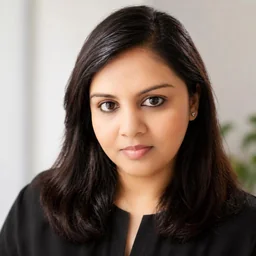
Radhika Choudary co-founded Freyr Energy to take rooftop solar beyond the metros
An engineer who had worked in solar in the United States came home to a country with brutal sun and almost no rooftop panels on ordinary houses. She co-founded Freyr Energy to close that gap, using local partners and an app to reach the small towns big installers ignore.
India has more sunshine than almost anywhere that matters economically, and for years it barely used any of it on ordinary rooftops. The panels that did go up sat on big commercial buildings and the homes of the wealthy in a few large cities. For a middle-class family in a tier-two town, going solar meant navigating unfamiliar technology, opaque pricing, a loan nobody wanted to give, and an installer who might never come back to service the thing. Most people just paid the electricity bill.
Radhika Choudary spent her early career in the solar industry in the United States, watching an entire market get built around making panels easy to buy. She came back to India, saw all that sun going to waste, and co-founded Freyr Energy in 2014 with Saurabh Marda to fix the part that was actually broken: not the technology, but the buying of it. This is how she went about it.
Early life and education
Radhika has kept her early personal life private, and there is no reliable public record of her birth year, so this piece will not invent one. Her training, though, points straight at what she went on to build.
She took an engineering degree at Osmania University in Hyderabad and then a master’s at Purdue University in the United States, one of the strongest engineering schools in the country she was studying in. That combination, an Indian engineering base and an American graduate education, put her in a good position to work in a US industry that was, at the time, well ahead of India’s on renewable energy.
Career before Freyr Energy
Radhika built her career in solar and heavy industry before founding anything. She worked at SunEdison, one of the biggest names in solar during its rise, along with Lanco Solar and the bearings and engineering group SKF in the US. That is real operating experience in how solar projects get financed, built and sold, not a founder arriving at clean energy because it was fashionable.
It matters because rooftop solar is not really a technology problem in India. The panels work. What was missing was everything around them: financing a household could access, pricing it could understand, and a local person it could trust to install and maintain the system. Radhika had seen a market where those pieces existed, and she came home to a market where they did not.
Why she co-founded Freyr Energy
The gap was obvious once you looked. India had committed to enormous solar targets, but rooftop adoption among ordinary homes and small businesses lagged far behind, especially outside the big metros. The reasons were almost never about the panels. They were about trust, money and convenience, the unglamorous middle of the transaction.
Radhika and Saurabh started Freyr Energy in Hyderabad in 2014 to own that middle. The idea was to make going solar feel less like commissioning an industrial project and more like buying any other considered household purchase: a clear quote, a financing option, a trained local installer, and someone accountable if it broke. She took charge of the commercial side, sales first and later business development, marketing and the people function, while Saurabh ran the other half of the company.
The model: local partners and an app called SunPro+
Freyr Energy’s answer to the reach problem is the most interesting thing about it. Rather than trying to put its own sales and installation teams in every town, which is slow and enormously expensive, the company built a network of local channel partners, entrepreneurs and electricians in smaller cities who sell and install solar under the Freyr system. Freyr gives them the technology, training, financing tie-ups and brand; they bring the local trust and the last-mile presence.
Holding that together is a proprietary app, SunPro+, which digitises the whole journey from a first enquiry to a working system: designing the installation, generating an accurate quote, arranging financing, and tracking the project. It turns a confusing, bespoke purchase into something closer to a repeatable process a partner in a small town can actually run. The technology, in other words, is pointed at the sales and service problem, not just the roof.
The early struggle
Rooftop solar is a hard, patient business, and none of the hard parts are the panels. Convincing a household to spend a large sum upfront on a fifteen-to-twenty-five-year asset takes trust that a young company has to earn slowly. Arranging finance is its own battle, because for years Indian lenders were wary of finance for residential solar. And a channel-partner model, powerful as it is for reach, means the brand’s reputation rests on the quality of hundreds of independent installers, which has to be trained and policed constantly.
On top of all that, this is a capital-hungry, thin-margin, policy-exposed sector. Subsidy rules and net-metering regulations shift from state to state and year to year, and a company selling to price-sensitive households feels every change. Building steadily through all of that, rather than burning cash chasing headline growth, is the quiet achievement here.
Funding and growth
Freyr Energy has raised in the region of 10 million dollars over its life, which is modest and deliberate for a company of its age, matching a sector where capital discipline matters more than blitz-scaling. An early Series A of about 1.5 million dollars came through IIX’s Impact Partners, a platform for impact investing, which fits a business whose returns are partly measured in clean energy delivered.
The larger milestone was a Series B of about 58 crore rupees, roughly 7 million dollars, in October 2023, led by the European development-finance backed EDFI ElectriFI, with participation from the Schneider Electric Energy Access Asia fund and others including Maybright Ventures. The mix of investors is telling: development finance and a global energy major, the kind of patient, strategic capital that suits infrastructure rather than a quick flip. The money went into widening the partner network and the product, pushing rooftop solar further into the towns that the first solar wave skipped.
Founder Snapshot
- Name
- Radhika Choudary
- Company
- Freyr Energy (rooftop solar for homes and small businesses)
- Role
- Co-founder and director
- Co-founder
- Saurabh Marda, co-founder and managing director
- Founded
- 2014
- Headquarters
- Hyderabad, Telangana
- Education
- Engineering, Osmania University; master’s, Purdue University (US)
- Before Freyr Energy
- SunEdison, Lanco Solar and SKF, largely in solar and industry in the US
- Model
- Channel partners in smaller towns plus the proprietary SunPro+ app for design, quoting, financing and tracking
- Funding
- About $10 million total; Series A ~$1.5M via IIX Impact Partners; Series B ~Rs 58 crore (about $7M) led by EDFI ElectriFI, October 2023, with Schneider Electric Energy Access Asia and others
- Recognition
- Radhika Choudary won the Women Entrepreneur Quest (WEQ) in 2017
- Status
- Private, Series B
Radhika Choudary’s net worth and what she owns
There is no verified public net-worth figure for Radhika Choudary, and any number attached to her name online has been invented. Freyr Energy is a private company that has raised only around 10 million dollars across its life and has not disclosed a founder shareholding, so there is no valuation or stake that can be turned into a personal figure from the outside.
What can be said honestly is that she is a co-founder who has held a significant operating role in the company since 2014, through several funding rounds, which means a real but illiquid and unpriced ownership in a growing infrastructure business. Whatever that is worth depends on where Freyr Energy goes from here. Any specific rupee figure you find online is a guess presented as a fact.
Growth strategy: three choices that did the work
The first was to solve the sale, not the science. The panels were never the bottleneck; trust, finance and service were. By building financing tie-ups and an accountable installation experience, Freyr competed on the part of rooftop solar that actually stops people from buying.
The second was the channel-partner network. Reaching tier-two and tier-three towns with a company’s own staff is punishingly expensive, and it is why most solar players cluster in a few big cities. By enabling local entrepreneurs instead, Freyr bought reach it could never have afforded to build directly, and gave small-town customers a face they already trusted.
The third was capital discipline. Raising modestly and from patient, strategic investors, development finance and a global energy company rather than momentum-chasing funds, suited a long-payback, policy-exposed business. It is a less glamorous way to build, and in hard infrastructure it is often the way that survives.
What Radhika Choudary’s story teaches Indian founders
The first lesson is that the real problem is often not where everyone is looking. A whole industry treated rooftop solar as a hardware and policy story. Freyr treated it as a distribution and trust story, and that reframing is the company. Founders who can find the actual bottleneck in a stuck market, rather than the obvious one, have most of the battle won.
The second is that distribution can be a moat. The panels are a commodity anyone can buy. A trained, motivated network of local partners across hundreds of towns is not, and it compounds over time in a way a product spec never does. In a country as large and as unevenly served as India, reaching the underserved customer is frequently the hardest and most valuable thing a company can build.
The third is about the shape of ambition. Freyr Energy is not a winner-take-all rocket. It is a steady, capital-efficient infrastructure company in a sector that punishes recklessness. That kind of building rarely makes headlines, and it is exactly what the clean-energy transition needs more of. A founder does not have to chase a unicorn to be doing work that matters.
Frequently asked questions about Radhika Choudary and Freyr Energy
Who is Radhika Choudary?
Radhika Choudary is the co-founder and a director of Freyr Energy, a Hyderabad-based rooftop-solar company she started in 2014 with Saurabh Marda. An engineering graduate of Osmania University with a master’s from Purdue University, she worked in the solar industry in the United States, including at SunEdison, before returning to India to build Freyr Energy.
What does Freyr Energy do?
Freyr Energy sells and installs rooftop solar systems for homes and small businesses, with a focus on reaching smaller towns through a network of local channel partners. Its proprietary SunPro+ app handles the whole journey, from system design and quoting to financing and project tracking, to make going solar simpler and more transparent.
What is Radhika Choudary’s net worth?
There is no verified public net-worth figure. Freyr Energy is private, has raised only about $10 million in total, and has not disclosed a founder shareholding, so any specific figure online is fabricated. Her stake is real but illiquid and unpriced.
How much funding has Freyr Energy raised?
About $10 million in total. That includes an early Series A of roughly $1.5 million via IIX’s Impact Partners, and a Series B of about Rs 58 crore (around $7 million) in October 2023, led by EDFI ElectriFI with participation from the Schneider Electric Energy Access Asia fund and others.
Who is Freyr Energy’s co-founder?
Radhika Choudary co-founded Freyr Energy with Saurabh Marda, who serves as co-founder and managing director. Radhika has led the commercial side, spanning sales, business development, marketing and human resources.
What can founders learn from Freyr Energy?
Two things. Find the real bottleneck: rooftop solar was stuck on trust, finance and service, not on the panels, and Freyr built its company around that. And treat distribution as a moat, since a trusted local partner network across small towns is far harder to copy than any product.
Your story could be next
Building a startup of your own?
We publish researched, permanent founder features like this one — profiles that keep ranking for your name and your company long after a social post fades. Sponsored placement, quoted per founder, with a guaranteed publish date.
Our newsletter
The Bright Story
If this one stayed with you, get the next one before chai — a single women-led story, researched and anchored only in verifiable facts. No noise, unsubscribe anytime.
Keep reading
Ezhil Subbian built String Bio to turn a greenhouse gas into protein
Deep Tech · BatteriesKajal Shah, the Dreamfly Innovations founder story
Waste-Tech · Automated SegregationHow Nivedha R.M. built TrashCon from a clogged drain at RVCE
Health AI · DeeptechHow Geetha Manjunath built Niramai, an Indian deeptech that screens for breast cancer without radiation
Deep Tech · DataPrukalpa Sankar turned a data-for-good startup’s internal tools into Atlan
Circular Economy · Plastic Waste TechHow Meha Lahiri built Recity Network into a bootstrapped circular-economy company
More for founders
- Women-led startup directorySearch 100+ women-led Indian companies by industry, city, funding stage and year.
- VC directoryWhich funds invest in India, at what stage and cheque size, and who they’ve backed.
- Startup trends & dataLive charts of women-led startups in India — sectors, funding stages and cities.
- Free founder toolkit100+ directories, grants, PR, templates, AI tools and India’s schemes.
- Funding MatchFind the government funding you actually qualify for — in 60 seconds.
- Templates & checklistsPitch deck, cap table, term sheet and founders’ agreement.
Comments
No comments yet — be the first to add one.